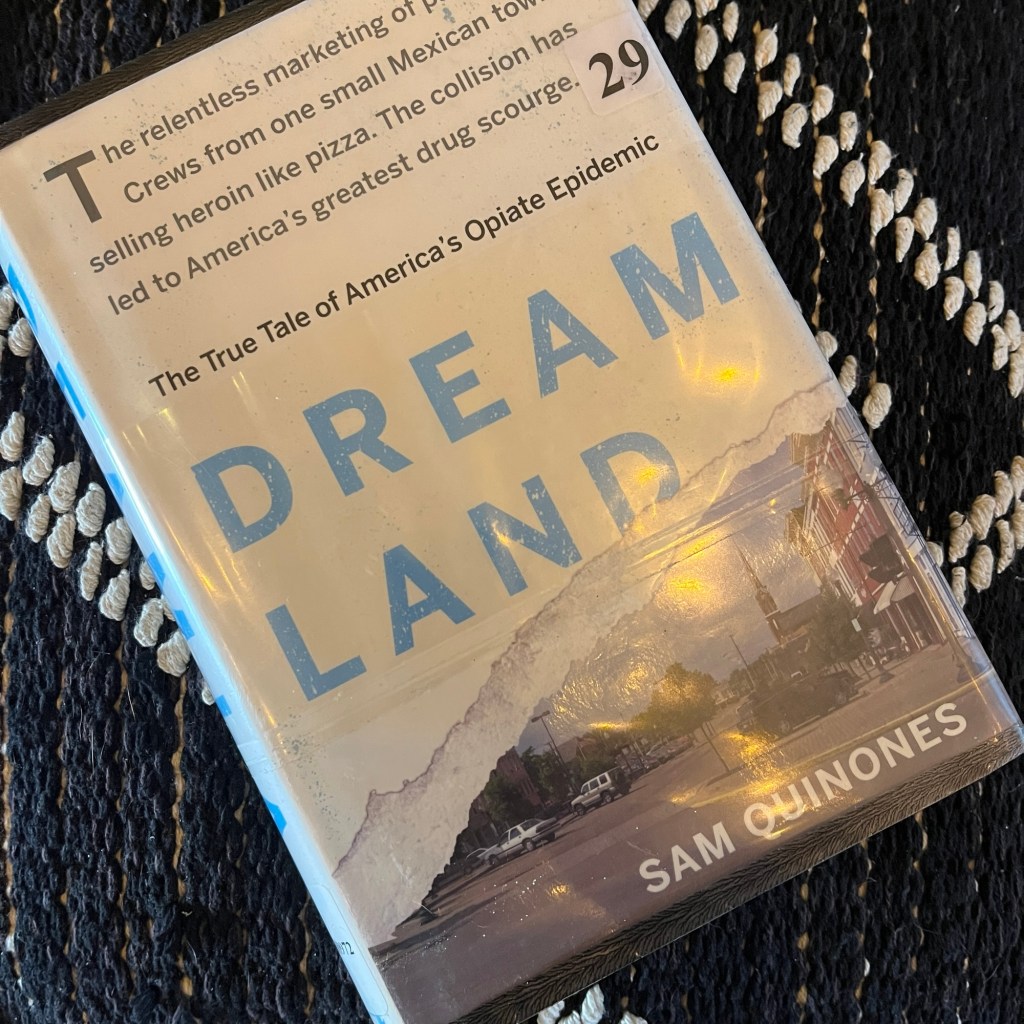
Finished on 9.26.25
This is a really fascinating book—it tells the story of how the opiate epidemic began and proliferated throughout the United States. I had nothing more than colloquial knowledge going into this, and it was really interesting to learn about the intersection of 1) the way pain pills were viewed and prescribed and 2) the pizza-delivery-style heroin trade from a specific area in Mexico combining to create the very specific situation the United States ended up in.
It’s also very well-written and very readable—I highly recommend if it’s a topic you’re interested in!
Click here to buy this book on Bookshop.org
My favorite quotes:
“WIOI, the local radio station, knowing so many of its listeners were sunbathing next to their transistor radios at Dreamland, would broadcast a jingle—‘Time to turn so you won’t burn’—every half hour.”
“In heroin addicts, I had seen the debasement that comes from the loss of free will and enslavement to what amounts to an idea: permanent pleasure, numbness, and the avoidance of pain. But man’s decay has always begun as soon as he has it all, and is free of friction, pain, and the deprivation that temper his behavior.”
“In 1853, meanwhile, an Edinburgh doctor named Alexander Wood invented the hypodermic needle, a delivery system superior to both eating the pills and the then-popular anal suppositories. Needles allowed more accurate dosing. Wood and other doctors also believed needles would literally remove the patient’s appetite for the drug, which no longer had to be eaten. This proved incorrect. Wood’s wife became the first recorded overdose death from an injected opiate.”
“Each autopsy physician had different ways of describing a heroin overdose. One used ‘acute intravenous narcotism.’ Another used ‘narcotics overdose.’ There was ‘polydrug overdose,’ though not officially listing heroin. Another used, simply, ‘heroin overdose.’ The numbers had been growing steadily, hidden in the tall weeds of inconsistent language.”
“Dispatchers sent pages to drivers that baffled investigators. Something like 181*2*3*0 told the runner to meet the addict three blocks north of the intersection of 181st Street and Halsey.”
“Every patient who was prescribed the drug stood a chance of soon needing it every day.”
“On some days, he saw patients for ninety seconds at a time, and issued forty-six thousand controlled-substance prescriptions—for a total of 2.3 million pills—in nine months.”
“I asked a detective, seasoned by investigations into many of these clinics, to describe the difference between a pill mill and a legitimate pain clinic. Look at the parking lot, he said. If you see lines of people standing around outside, smoking, people getting pizza delivered, fist-fights, and traffic jams—if you see people in pajamas who don’t care what they look like in public—that’s a pill mill.”
“He did a three-year fellowship in neurology. He had no tutelage in pain management. No one did in medical school. ‘Just because it’s a problem every doctor faces every day,’ he said, ‘doesn’t mean that it’s something you would run into in medical school.’”
“‘My fellowship director even told me, “If you have pain, you can’t get addicted to opiates because the pain soaks up the euphoria.” Now you look back and it sounds so preposterous. That’s actually what people thought. You can think what you want in the face of ten thousand years of reality.’”
“‘By the time you were in a position to have a lawsuit against Purdue Pharma, you were already likely to have fucked up so badly that you wouldn’t work as a class action plaintiff.’”
“‘When I was selling Oxys, it was a certain group of people,’ he told me. ‘When I come home, it was a certain group of people plus everybody else. Cops’ kids. Poor kids, rich kids, smart kids, dumb kids.’”
 kristin reads
Leave a comment