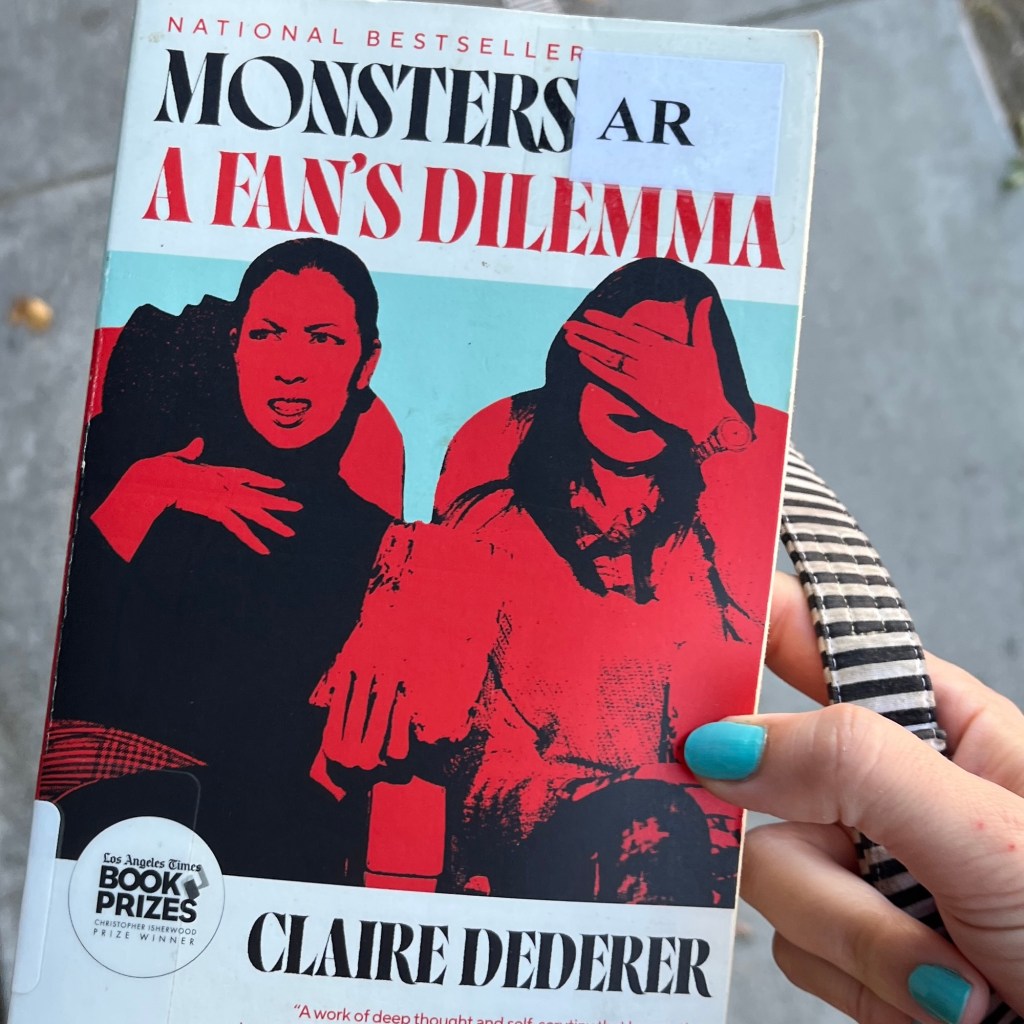
Finished on 11.2.25
This book frustrated me. It didn’t give me what I wanted or needed from it at all, really. It felt much more like a personal exercise for the author, and if she got what she needed out of it, then good for her! But chapters upon chapters about motherhood and her own internal struggles and guilts were not at all helpful to the audience in answering the question she was initially posing—can / should we separate the art from the artist?
Click here to buy this book on Bookshop.org
My favorite quotes:
“It’s too easy, when we’re running the calculus, to forget love. Love that is a quiet voice next to the louder call of (even deserved) public shaming. Critical thought must bow its knee to love of the work—if something moves us, whoever we are, we must give that something at least some small degree of fealty.”
“The genius’s freedom does not concern itself with the care or schedules or feelings of other people. The genius has absolute license. The genius gets to do what he wants. When I tried that, all I ended up with was a drinking problem and a lot of annoyed friends.”
“If language needs to have effected action in order to be objectionable, haven’t we just let every raging bigot who doesn’t actually hold political office off the hook? Anti-Semitism isn’t only wrong when it contributes directly to a Holocaust.”
“We think they didn’t know. And at the same time, we believe we would’ve done better. This time-traveling impulse is crucial: we, like Stephen Fry, want to hurtle back in time and sort of spritz our enlightened-ness all over the place.”
“Institutional presence matters. Taking up space in cultural institutions is meaningful, whether that’s as an artist or as an administrator. It’s not a perfect solution to the monster problem. It’s wrongheaded to think that people from historically oppressed groups will never be monstrous. A person’s identity does not automatically make them bad; and it does not automatically make them good either. I don’t think that if institutions start supporting women and people of color and queer people and trans people, all those people will turn out to be good. But I do think the institutions will be better, simply because they will be fairer.”
“Whenever a protagonist got pregnant, I experienced a sinking feeling—in fact, I felt a vast boredom utterly unique to this reading circumstance. Now the protagonist would lose her options; now her world would be constrained to the four walls of a house, and what kind of plot would that be?”
“Passing the problem on to the consumer is how capitalism works. A series of decisions is made—decisions that are not primarily concerned with ethics—and then the consumer is left to figure out how to respond, how to parse the correct and ethical way to behave.”
 kristin reads
Leave a comment